People who are mean to others are not happy with themselves.

  • Post author:

When someone is mean to you, you might be tempted to strike back at the other person with harsh words or impulsive actions. But most of the time, this can make the situation worse. When you can take a step back and not take their attack on you personally, you can respond in a calm rationale way that you are proud of. You also may be able to see the person in a different light and avoid getting pulled into a cycle of endless battles and competitiveness.

When you see a person who is lashing out at those around them, remind yourself that their behavior is not without a cause. People are rarely aggressive and cruel for no good reason. Most likely, they are hurting on some level. Maybe they’re going through some difficult challenges, and they aren’t handling them too well. They may have recently suffered a painful loss, so they’re angry at the world and looking for ways to vent that anger. Perhaps they think that spreading their misery around will make them feel better. So they will go around saying hurtful things, deliberately picking fights, or maybe even trying to sabotage you in various ways. It can be exhausting.

It’s natural that your first reaction might be anger and defensiveness. And you might feel like striking back is the only way you can stand up for yourself. But try to stop yourself from immediately reacting. Yes, young padawan, there is much wisdom in thinking through your response first. 

People who are unhappy with themselves, will inevitably attempt to drag you down to their level into a game that you cannot win. Remember, misery loves company. The harder you fight back, the harder they will keep pushing, and the conflict will only escalate. In a very real sense, when you do this, you are handing over your power to the other person. You are no longer in control of your own words and actions, and you are allowing them to decide the course of events.

The only way to win battles like these is to refuse to fight at all. Of course, that doesn’t mean that you have to sit back and allow yourself to be victimized, either. The truth is, if we understood how often people cope by projecting, we wouldn’t take much of what they say personally

If you can learn how to detach yourself from what is being said, you will understand that their hostility has nothing to do with you at all. You just happen to be a convenient outlet for venting their feelings in the moment. And when you can take a step back, that buffer will prevent you from being reactionary and impulsive in your actions.

Next, remind yourself that no one else has any power or control over your own mood and mindset, unless you choose to give it to them. No matter what anyone else says or does, you have the power to stay centered and calm within yourself. From this calm inner state, you will be able to see the best course of action to safeguard your well-being.

How you choose to respond is up to you. You may feel like you need to put some distance between yourself and the other person until they calm down. Or you may decide to respond with compassion and understanding. Many times, when someone is mean, they don’t expect someone to be compassionate.

However you choose to respond, you will be making a conscious decision to step out of the role of victim and keep your power where it belongs – within yourself. And as a bonus, you will continue to build yourself up by responding to situations like these, in ways you are proud of.

Continue ReadingPeople who are mean to others are not happy with themselves.

He learned to play it safe. And he never, ever got noticed by anyone.

  • Post author:

In many posts, I talk a lot about how a comfort zone is a beautiful place, but nothing ever grows there. While our comfort zones feel like a safe place, the truth is, if we choose to stay there, we will never experience the things that are out there that ignite our soul.

This quote comes from an episode of Star Trek, where Captain Jean-Luc Picard has died due to his artificial heart. He sees Q in the afterlife. Q gives him a chance to go back to the bar fight that caused him to lose his original heart. When get gets there, he is a junior officer, not a Captain. When he asks Q about it, Q tells him that he never became a Captain in that timeline because he never had a brush with death or came face to face with his own mortality. He said that this version of the Captain never realized how fragile life is and that his life never came into focus. He had no plan or agenda, he just kind of drifted, never seizing the opportunities that were there for him to become greater. Q says that this version of the Captain learned to play it safe and he never, ever got noticed by anyone to become Captain.

When it comes to living the life you’ve always wanted to live, you have to take chances and seize the opportunities when they are there. The reality is excuses for why we can’t do something right now will always be there. But opportunity won’t.

We are all here on this planet for a limited amount of time. We don’t know how long we have. We are perishable items, yet we put off things and live like we have time. Time is promised to no one. We don’t have time and cannot afford to live in potential for the rest of our lives. At some point, we have to make our move

Continue ReadingHe learned to play it safe. And he never, ever got noticed by anyone.

You’d be surprised who’s watching your journey and being inspired by it. Don’t quit.

  • Post author:

When we are focused on our own journeys, we often don’t realize that some people are watching us, silently cheering us on. We all love the underdog story and watching people overcome obstacles to reach their dreams. Their stories inspire us to make our dreams a reality, too.

I’ve written extensively about failure and setbacks. In a post last year, I wrote about how we will never be motivated 100% of the time to keep going. What will carry us through those times is discipline and internalizing our why. In another post I talked about how failure is not falling down. It’s refusing to get back up. Be the one who gets up after falling down every single time. Show the people who are watching that it can be done.

When you feel like quitting, remember these things:

  • Decide that no matter what happens you are not going to give up.
  • Where there is a will, there is a way.
  • Giving up on your goal because of one setback is like slashing your other three tires because you got a flat.
  • Rejection is just redirection and experience.
  • It is our journey that teaches us more than arriving at our destination.
  • There’s a reason for closed doors, unanswered prayers and blocked roads. If your plans aren’t working out right now, it’s because there are better things waiting for you.
  • You haven’t come this far, to only come this far.
  • The moment you are ready to quit is usually right before a miracle happens.
  • Even your worst days are only 24 hours long.
Continue ReadingYou’d be surprised who’s watching your journey and being inspired by it. Don’t quit.

Don’t believe everything you hear. There are always three sides to the story: yours, theirs and the truth.

  • Post author:

Have you ever heard two sides of an argument? While it’s the same story, they sound completely different! So who is telling the truth? How do you know who is right and who is wrong?

At the end of the day, no one is telling you the absolute truth. There are always three sides to a story: the two conflicting ones, and the absolute truth. This isn’t because they are deliberately trying to lie to you. Rather, it’s because there is always a bias, a perspective, and emotions that affect how they perceived the event. It is THEIR truth and it’s valid.

But why are there three sides to a story, even when no one is explicitly lying?

Why There Are Three Sides to Every Story

Personal Bias

As humans, we are never going to be perfect. So, it’s important to also take into consideration that sometimes when we relay a story, we might tweak it according to what serves us in the best way possible. This can even happen without us realizing it, at the subconscious level. It’s human tendency to protect ourselves and avoid rejection.

For example, imagine you had a fight with your partner because you asked him to clean the kitchen but he didn’t take out the trash. He feels you are at fault, because you didn’t tell him to specifically take out the trash. He feels like you are mad at him for no reason because to his mind, you never asked him to take out the trash. He cleaned the kitchen, like he was asked to. But to you, your definition of cleaning the kitchen entails taking out the trash. When you tell the story to others, you might say “I told him to take out the kitchen trash” because to you, that goes without saying when you clean the kitchen. That’s your personal bias.

A personal bias is what happens when we share what serves us. It’s what we think is the truth, or at least what we want the truth to be.

Emotions

Emotions play a huge role in how we perceive an event. For example, when we are stressed out, the smallest comment can feel like a personal attack. When we think about the event later, we might realize that an innocent question like “Did you pay the bills?” felt like judgment in the moment. In an emotional moment, if you are stressed, sad, or angry, you might feel like the other person was suggesting that you were forgetful or irresponsible. This can lead to your version of the event where you believe that the other person is complaining. This can lead to a conflict, where you believe your partner is “always complaining” (leading to the following point).

Cognitive Distortions

As humans, we all have cognitive distortions, impacting the way we interpret and perceive an event. Some common cognitive distortions are exaggerating, over-generalizing, or seeing things as black and white. When we view events through a distorted lens, we can often blow things out of proportion. As mentioned in the example earlier, accusing your partner of “always complaining” is a cognitive distortion, as it is a generalization. Words such as “never”, “always”, “all the time” are key indicators that you might be seeing the event through a distorted lens.

As it’s often said, life is not just black or white; there is always a gray area. The same goes for any conflict or story as well. Whenever someone tells you a story, it’s coming through their perspective and how they experience it. Even if they aren’t lying or trying to deceive you, it is bound to be a slightly different version of the absolute truth.

Continue ReadingDon’t believe everything you hear. There are always three sides to the story: yours, theirs and the truth.

There’s no such thing as a free lunch.

  • Post author:

This quote was coined by an economist, but it actually extends beyond the economy into daily life. Essentially, it means nothing is free.

Of course, you probably already know that. But what about the free samples in the store? Or the birthday lunch that your best friend paid for?

There is Always a Cost

While goods or services can appear to be free of cost at times, like the samples or lunch I mentioned earlier, there is always a cost to everything. Even the free samples took money to make. The lunch paid by your best friend still cost money; the only difference is that you didn’t pay for it.

Now let’s say a friend took time out of their day to help you fix your kitchen sink. What’s the cost? That seems to be free, right? Again, if you look deeper, it’s not. The cost doesn’t always have to be material, it can also be time or energy. So, when someone comes to help you, they are spending their time and energy.

Everything has a cost. And the biggest cost for everything is our time.

Consider What Your Cost Is

Whenever you are given the opportunity to enjoy something for free, whether it is a free sample or a free YouTube video, consider – what is the cost you are paying? Perhaps it is as simple as eating something you don’t really want to (in the case of a free sample) or being sold a thousand-dollar program you don’t need right now. Or maybe it is your time and energy.

While I say this, sometimes the cost is worth it. Maybe you are spending your time, but you are gaining knowledge or entertainment or relaxation.

The bottom line is, be aware of the costs that you may overlook at first.

Motivate Yourself

When you realize that nothing is free, and you need to spend your time and energy, you can then motivate yourself more effectively.

For example, let’s say you want to finish writing a book, but you keep procrastinating. You can’t figure out why, because you are doing it for yourself, so it feels ‘free’.

But, based on the concept that nothing is free, you now realize that even YOUR service (writing) isn’t free. Knowing this, you can now come up with different ways to compensate yourself for your own service. So, you might ‘pay’ yourself with a dessert, or a walk along the beach. Maybe you ‘pay’ yourself with an internal reward, such as praise or a sense of achievement. At its core, this is the concept of intrinsic and extrinsic motivation.

Be Grateful

And finally, practice being grateful for everything around you. Even if it seems free, like free WIFI at the store, someone put in their time and energy to make it available to you.

Understanding that nothing is truly free, we can begin to appreciate the little things we often overlook. We have an opportunity to be a little more mindful of who is paying the cost, and what the cost is. And a lot of times, the cost is worth it!

Continue ReadingThere’s no such thing as a free lunch.

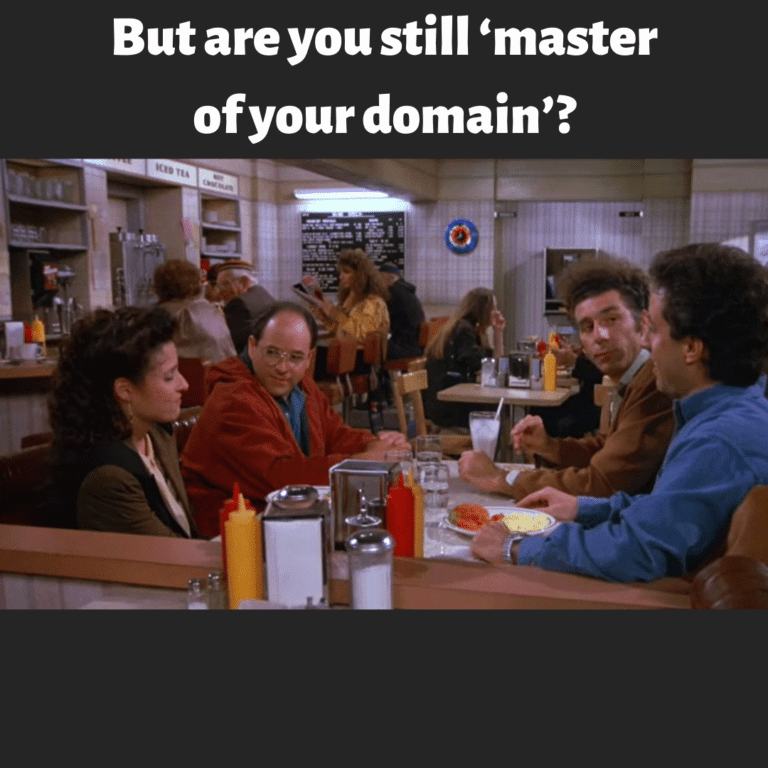
But are you still ‘master of your domain’?

  • Post author:

I never watched a Seinfeld episode until I took a Pop Culture & Philosophy course where I had to watch it for the semester. By the time I was watching it, it was a little dated, but oh my goodness had I been missing out on a great show!

The Contest is one of my favorite episodes. In this one, Jerry, George, Elaine, and Kramer hold a contest to see how long they can all go without masturbating. Because NBC did not want the show using the word “masturbation”, the catchphrase “master of my domain” was used. In the end, the episode was very successful and reviewers said that they were able to cover a controversial subject in an inoffensive manner.

The deeper meaning behind this episode is the idea of not just giving into self or instant gratification. And it can be applied in every area of our lives, not just masturbation.

In our society, we have immediate access to everything. We can get food delivered to our door with the tap of a button. We can get virtually anything we want delivered by the Amazon elves overnight.

The other night around midnight, I realized that we had run out of Zevia cola before I went to bed. I went onto Amazon, ordered it and the Amazon elves brought it to our house by 8am the next morning. How crazy is that, when you really think about it? When I was a kid, one, there wasn’t Zevia, and two, if you wanted to make a purchase like that, you had to physically go to a store and get it off the shelf. You actually had to plan ahead.

We are living in interesting times. I love the convenience, but the options we have today exacerbates our desire for instant gratification. And on a large scale, it changes our brain chemistry.

In a TEDx Talks, John Davidson from GameStop talks about how instant gratification is harming society. It’s interesting!

Continue ReadingBut are you still ‘master of your domain’?

Often people who criticize your life are the same people that don’t know the price you had to pay to get to where you are today.

  • Post author:

It’s easy for people to criticize and judge you based on limited information or perceptions they have. They don’t know the full story of everything you have been through in your life. Maybe on the surface you look like you’ve got it all together and you really haven’t had to struggle for much of what you have. Some people are apt to feel resentful that life seems to be so easy for you. But the reality might be that you have had to fight for every scrap of success you have achieved.

People are also quick to make assumptions about why people are where they are in life. For example, people might have the impression that you are unmotivated, lazy, or incapable of doing better – which may not at all be true. Maybe you haven’t been able to live up to your fullest potential in life yet, simply because you have had many struggles and challenges that have held you back. Or maybe you have been dealing with an illness people don’t know about.

Regardless of the current reality, when someone is criticizing and judging you, it hurts. And when they minimize the battles that you have had to fight throughout your lifetime, you might feel compelled to set them straight. Or at the very least enlighten them with the truth and justify your current position. You might point to the struggles you have had to work through. Or try to change their opinion of you by making them see the situation from your perspective.

The problem is that such justification rarely, if ever, changes anyone’s opinion. Most of the time, they have already made up their mind about you, and anything you say will probably only cause them to dig in their heels and resist seeing the situation, and you, differently. And the truth is, some people are just content to be critical of others because it distracts them from how they feel about themselves.

Rather than trying to change their mind, accept that they don’t know the full story, and they don’t need to know it. It’s not your responsibility to convince anyone of anything, or to change their opinion of you. Only you know the unique circumstances that have brought you to where you are today. Only you know the struggles that you have had to overcome, and you don’t need to justify any of it to anyone.

When you stop caring so much about other people’s opinions of you, you begin to see the disturbing truth that some people have made a career of criticizing others. Why? Because they feel better about themselves when they are peering down from a position of superiority.

However, an interesting thing happens when you stop caring so much about other people’s opinions of you. Your own level of self-respect starts to grow deeper and stronger. You start to develop a stronger sense of appreciation for your own resilience and tenacity. You even start to feel a sense of healthy pride about everything you have gone through, all of the battles you have won, and everything you have achieved in your life up to this point. And you feel this even if others might not see it.

Remember, no one can make you feel inferior without your consent. The only opinion about you that matters is your own.

Continue ReadingOften people who criticize your life are the same people that don’t know the price you had to pay to get to where you are today.

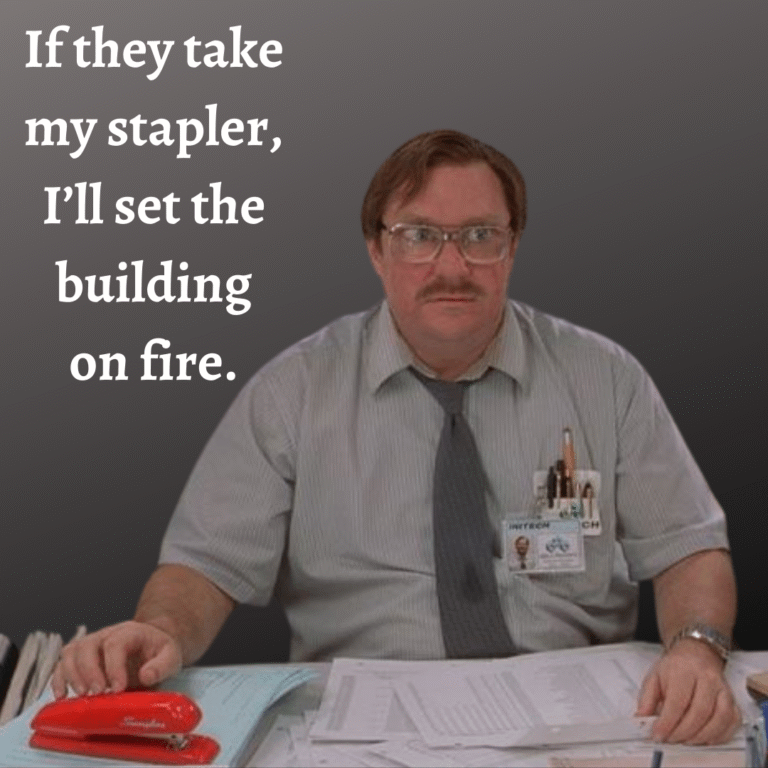
If they take my stapler, I’ll set the building on fire.

  • Post author:

Ahhhh, Office Space. This movie was released in 1999, and over two decades later, so many of us can still relate to the ridiculousness dynamics in an office working in corporate America. Inside the mundane, Groundhog Day-esque realm of our workdays, the corporate overlords rule over us, having no idea how things really get done. And every office space has their Milton. 

In Office Space, Milton is always slighted in some way. He doesn’t get cake on birthday celebrations; his desk is moved to the basement, and no one really takes him seriously. He’s always brushed off. While he always remains calm and meek, he mumbles that he will set the building on fire. And no one takes him seriously. Until one day, lo and behold, the office building is a raging inferno.

The lesson here is that everyone has a breaking point. In Milton’s case, he didn’t actually burn down the building because they took his beloved red swingline stapler. He did it because of all the abuse he suffered on the job.  

Obviously, burning down your office building isn’t the best way to address your feelings about how you’re being treated – just saying. But even the most patient and kind people have a final straw that causes them to break.

I have found working with many kinds of people, that there are two things that are universal. Showing people basic kindness and validation can go a long way – especially in a challenging work environment.

Continue ReadingIf they take my stapler, I’ll set the building on fire.