Experience is not what happens to you, it is what you do with what has happened to you.

  • Post author:

Your life experiences up to this point have contributed to the person you are today. You can probably point to plenty of good and bad experiences in your past. But what makes an experience good or bad? Enduring pain or loss might be considered a bad experience, but what if you also gained something valuable from that same experience? It is only your personal perception that determines whether something is positive or negative.

Painful experiences can easily foster bitterness and resentment, or they can usher in wisdom and gratitude. They can cause you to feel victimized, or they can awaken an awareness of your inner strength. They can tempt you to close down and guard your heart more carefully, or they can encourage you to reach out to help others in a more meaningful way. You are the only one who can decide which it will be.

Take a moment right now to think about some of your past experiences that you would deem to be negative or unwanted. Did anything positive come from those situations? Perhaps an unfortunate mishap led to meeting the love of your life or a trusted friend. Maybe you lost your job, but ended up getting a much better one shortly afterward.

At the very least, your painful experiences undoubtedly taught you some valuable lessons and you are much wiser now because of them. Do your best to find a hidden blessing, a benefit, or a powerful insight that you gained from each experience. This will help you to shift your perception and release any feelings of sadness or bitterness that remain from those experiences.

Moving forward, one of the most powerful habits you could develop is the ability to be dispassionate and calm in the face of adversity. Acknowledge that you are facing a challenge or an unexpected turn of events, then take a deep breath and turn your attention inward. Focus on your heart center and stay present in the moment. Rather than resisting the events or reacting emotionally, surrender to what is and consider that it might not be as bad as it seems.

Then ask yourself, “Where would I like to go from here?” Think about where you would like this situation to lead. Think about all the possibilities now stretching out before you. Consider ways that you might turn this challenge or setback into something even better than you had before.

Even if you aren’t sure where you’d like to go from here, simply express your intention to turn the situation into a worthwhile experience. Say, “I don’t know how, but something good will come from this situation.” Or say, “I’m open to the world and all its possibilities.”

Holding an open, optimistic attitude like this will do two things. First, it will make you feel more centered and empowered in the moment, even if circumstances are not as you wish them to be. Secondly, it will draw forth plenty of inspiration, ideas, and opportunities. These can help you turn the situation into something that you will one day look back on with a genuine sense of gratitude.

Continue ReadingExperience is not what happens to you, it is what you do with what has happened to you.

We are all addicted to something that ruins us.

  • Post author:

On some level, I think all of us struggle with moderation. It doesn’t even matter what it is. We can all become addicted to things that ruin us. Never before have we had pretty much instant access to things we want – food, sex, drugs, shopping, etc. They are all just a click away these days.

A couple of month ago, I posted an interview from Be Inspired of neuroscientist, Dr. Andrew Huberman. He talked about how the problem we have today isn’t pleasure itself, but the instant access and minimal effort needed to get it. He made the argument that a good life is a progressive expansion of things that bring you pleasure through motivation and hard work.

https://www.youtube.com/watch?v=jBwM-mCLQQo

In thinking about my own struggles with moderation, I’ve discovered that whatever it is that I eat or buy or whatever, it really isn’t about the actual thing. It is about the feeling I associate with it. For example, I recently discovered that our local grocery store carries Carvel ice cream cakes. Wow – we are thousands of miles away from home and now we can get Carvel here! Yay! But I have found myself wanting to buy these small ice cream cakes every single time we go to the store.

For me, it’s about the feeling I associate with the smell and taste of it. And it took me thinking about what is really driving my feelings to figure it out. The feeling I associate with it is my childhood (Carvel is big in New York, Connecticut and New Jersey) and feelings I had of less responsibility and freedom as a kid. It also reminds me of times spent with my family doing things in the summer months, then walking inside a Carvel shop at night for some ice cream. Ah, nostalgia. You’ve done it again.

For me, slowing things down and understanding why I became obsessed with these cakes at the store helped me understand my feelings better. And more importantly, it helped me create other ways to experience those fond memories and feelings associated with them without having regular servings of ice cream cake. But you know, for my birthday, I wouldn’t object to a Carvel cake – just saying.

Continue ReadingWe are all addicted to something that ruins us.

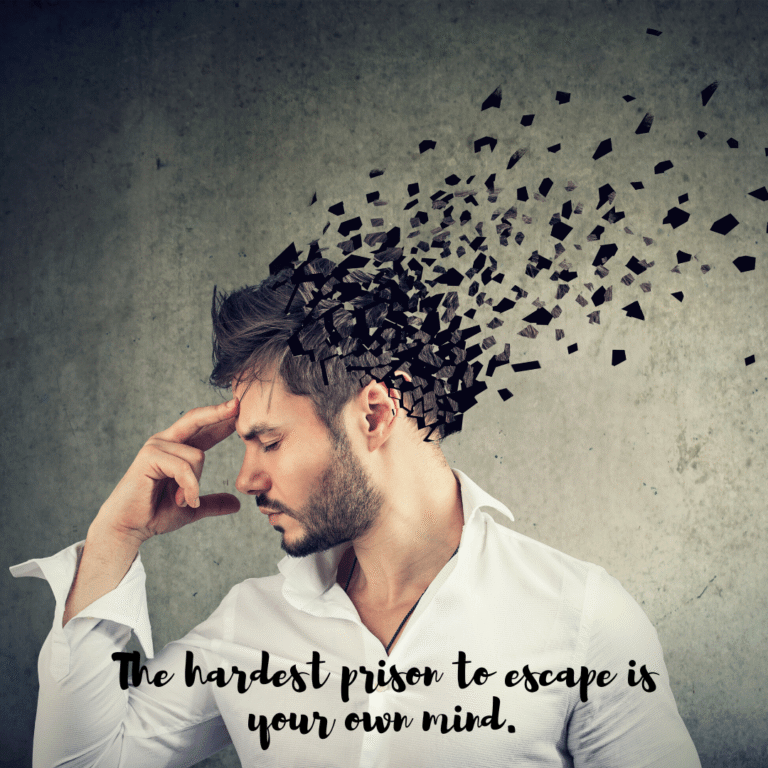
The hardest prison to escape is your own mind.

  • Post author:

I’ve talked a lot about confirmation bias and how we can stay stuck inside our own heads. Our brains can either be our passport or our prison. It’s either your best friend or your fiercest opponent. But the good news is that you have the power to take back control.

One of the reasons why we stay stuck in our own heads is because we get caught up on our own thoughts. And it is really easy to do! While it’s important to acknowledge what we are feeling in the moment, by focusing on them too much, it can paralyze us.

Here are some things to remember when your thoughts start to consume you:

1. You are not your thoughts. Everything we identify ourselves with has to do with our thoughts and thought patterns. Our personalities and emotions are crafted because we attach ourselves to our thoughts, and that’s who we believe ourselves to be.

Since a good portion of our thoughts are negative, we relate more to complicated emotions like fear and guilt, leading to debilitating illnesses like depression and anxiety.

It’s important to understand that you are not the thought; you are the receiver of the thought. And you have a choice to accept or decline, especially those that don’t serve a positive purpose. Understanding this concept can bring positive results and help the healing process.

2. Detach yourself from your thoughts. Detaching from your thoughts will be difficult at first because you’ll notice an abundance throughout the day once you start becoming aware. And it’s impossible to catch all of them. Likewise, habits, especially internal habits, are challenging to break.

When trying to detach from your thoughts, think of it like you’re receiving a message from an unknown sender, and you have the choice to either accept it or let it go. Acknowledge the thought, and then let it go. Visualize those thoughts as waves in the ocean. Just as they rise and you are aware of their presence, they will eventually come down. This exercise can help you start the process of being mindful of what you are experiencing and feeling, but also letting them go and not consuming your thoughts.

3. Meditate. Meditation is a great tool to clear your mind of unnecessary clutter and can help you relax and reset. In addition, it really helps you stay mindful and in the moment.  

Just as it’s tough to become aware of your thoughts, sitting still and inner stillness can also be challenging. You never know how many thoughts you have until you try to meditate. So, start small and work your way up.

For example, start with 5 minutes for one week and add minutes the next. If you find your mind wandering during meditation, that’s normal. It means that you’re becoming aware of your thoughts. When you realize you’ve drifted, go back to the meditation. You can also choose guided meditations to start. You’ll find that you can focus more while someone is giving you instructions.

Remember, we are all living in cages with the door wide open. Like Morpheus says in The Matrix, we need to free our mind. You have the ability to determine what your beliefs are about yourself and the world around you and your experiences.

Continue ReadingThe hardest prison to escape is your own mind.

Ignorance leads to voluntary misfortune.

  • Post author:

Ignorance is a choice. If you choose to be ignorant, that you are welcoming the possibility of misfortune. And that is exactly what I did in college.

One semester, I took an English Literature class. On the second day, he handed out a test. I was shocked. I raised my hand and asked what the test was over as we hadn’t been assigned anything to read. He smirked and put the test down on my desk. I read the words, “Syllabus Test.” Ugh. Clearly, having only skimmed the syllabus the day before, I missed the part saying there would be an exam. And naturally, I failed the test because I ignored the information given in my resources to pass. Yes, off to a great start, precious. Lesson learned.

When you choose to not do your own due diligence with things, you invite the real possibility of misfortune. These are things that could potentially have been avoided if you had taken the time to educate or prepare yourself. But could there also be a benefit to ignorance?

Before you say no, consider this. In a Tedx Talks, Tom O’Neill talks about the power of willful ignorance. He talks about how mankind has achieved things because they were ignorant to the fact that it couldn’t be done:

Continue ReadingIgnorance leads to voluntary misfortune.

Vulnerability is the birthplace of innovation, creativity and change.

  • Post author:

Some of the most tortured souls have created art, music and stories that resonate with us on a deep level. Yet many people spend most of their lives trying to avoid being exposed or vulnerable. Many of us equate vulnerability with weakness. But I think daring to be vulnerable with others is actually a strength. 

According to Brené Brown, a research professor, author and expert on shame and vulnerability, fear of shame inhibits creativity, keeping us hiding in case we are not worthy or good enough. Those of us who have shown ourselves, battered, broken, and not feeling good enough have touched so many lives and changed the world. They are the ones who have created beauty in all that surrounds us.

I think about the musician Leonard Cohen. In 1984, his song Hallelujah was released. He is the original writer and performer of this song, but many people don’t realize it because it has been covered by so many other artists. This song has moved the world, and it was written at lowest point in his career. Executives at Cohen’s label didn’t even listen to the song and were reluctant to even release the album. But they eventually did. A few years went by, and his song resonated so much with other musicians, that they began covering it. And it gained much more attention with music fans as a result.   

Brené Brown is famous for saying, “Vulnerability is the birthplace of innovation, creativity and change.” She spoke about this extensively during a TED Talks from 2012.

Real life struggles and challenges are what stay with us the most. Whether depicted in music, art, writing, business or through change in our society. As people, we will always seek affirmation of our human condition when it comes to our feelings. We want to know that we are not alone.

Continue ReadingVulnerability is the birthplace of innovation, creativity and change.

My recovery must come first so that everything I love in life does not have to come last.

  • Post author:

When you are in recovery for any kind of addiction or “problem behavior”, your wellness and recovery must come first. Taking your recovery first is being accountable and responsible for yourself. It isn’t selfish. Addiction is a tricky thing – it wants you to go back and have a reason or rationalization for it. It’s kind like Gollum and the ring. He is always seeking to recover his precious, even though it has destroyed the man he once was (Smeagol).

A solid recovery program must be front and center for any addict. It doesn’t mean that other things like earning a living, maintaining relationships, etc. aren’t important. They are. You see, the problem that most addicts face when getting sober is they have no idea how to prioritize healthy things in their life. While in active addiction, their priorities revolved around getting drunk, high or engaging in their problem behavior. Once in recovery, those priorities are gone and it’s difficult to know how to focus on things you neglected while you were in active addiction.

So, what does making your recovery come first look like? Well, it isn’t spending every waking minute sitting in meetings or focusing on not using. It’s defining all the things you need to do to stay in recovery and be well and prioritizing them every day. Maybe that means going to a meeting before or after work every day for a while. Maybe its spending some time meditating or working out. Whatever things you have found that helps you stay sober should be part of your daily habits.

Another thing worth mentioning is changing your people, places, and things. You cannot heal in the same environment where you got sick. Obviously, this means the people, places and things that supported you being in active addiction. But it is also people, places and things that stir up emotions inside you that trigger you to wanting to use. Maybe you can re-incorporate them into your life further into your journey once you develop healthier coping skills. But it is okay to let go of these things if having them in your life causes your sobriety to be in jeopardy. 

Remember, if you want to be able to show up for others, you have to take care of yourself. And you can’t be of service to others if you don’t take care of yourself first. I know many people who are recovering addicts who are drug counselors now. And they know that if they don’t look after themselves, they can easily slip back into unhealthy patterns and routines that make them vulnerable to slipping up or a relapse.

Continue ReadingMy recovery must come first so that everything I love in life does not have to come last.

Facts are stubborn things.

  • Post author:

I have a little side project I have been working on with friends. We are investigating a series of criminal cases were information presented at the time of trial may have been incorrect. These potential discrepancies revolve around the “art” of forensic science, which can be incredibly reliable in some respects, and not so reliable in others.

As we have been looking into these cases, we are shocked at some of the facts that have come to light. I’ve always seen myself as an objective truth seeker – regardless of where the truth leads. In a re-examination of this information, we now have facts that tell a different story. And that story matters.

But let’s go back to history for a moment. In 1770, lawyer John Adams, who became the second president of the United States, was asked to aid the legal defense for the British soldiers who participated in the Boston Massacre. His fellow colonists were obviously upset about this. But his defending argument included the quote, “facts are stubborn things.” Recorded in a 1788 history book [JABM] it reads:

“I will enlarge no more on the evidence, but submit it to you, gentlemen—Facts are stubborn things; and whatever may be our wishes, our inclinations, or the dictates of our passions, they cannot alter the state of facts and evidence: nor is the law less stable than the fact. If an assault was made to endanger their lives, the law is clear, they had right kill in their own defence.”

Adams was arguing that the law is the law and the facts of what happened was in line with the law. But he noted that no matter what we wish to be true or what we feel happened, it cannot alter the state of facts and evidence.

We see this issue come up often when someone is arrested for a crime. Before Chris Watts was arrested and before we even knew what was going on in his marriage, as a society we believed he was guilty, without any facts or supporting evidence. Same thing with Scott Peterson.

As a society we make these assumptions based on what we feel must be true. It is what makes sense to us. And most of the time, a victim is killed by someone close to them. Perhaps we are right in our assumptions. And maybe someone even knows it firsthand. But when it comes to law, it isn’t what you know, it is what you can prove – at least it is supposed to be. And facts are supposed to matter.

Continue ReadingFacts are stubborn things.

To be yourself in a world that is constantly trying to make you something else, is the greatest accomplishment.

  • Post author:

Last year I wrote a post about when you live for people’s acceptance, you will die from their rejection. In it, I was pretty vulnerable and talked about my own feelings of not being good enough and being so dependent on external validation that I really lost my way. You can read the full post here, but I wanted to share some things you should remember if you are struggling with being yourself:

  • Nothing outside of you can ever take away how you feel about yourself.
  • Being real and authentic with yourself, flaws and all – the good, the bad and the ugly and accepting it is the solid foundation of building self-worth.
  • Be gentle with yourself. If you spoke to a friend the way you speak to yourself, what would they say?
  • Eliminate negative self-talk and focus on positive affirmations.
  • Always be improving yourself for you. What are you good at? What are you interested in?
  • What other people think of you is none of your business.
  • There is only one “you”. You have something that only you can give to this world.
  • You are unshakeable and incredibly resourceful.
  • When you begin to love yourself, you will tolerate less nonsense.
  • Your value doesn’t decrease based on someone’s inability to see your worth.
  • You owe yourself the love that you give so freely to other people.
  • Stop hating the experiences that shaped you.
  • The same light you see shining in others is in you, too.
Continue ReadingTo be yourself in a world that is constantly trying to make you something else, is the greatest accomplishment.