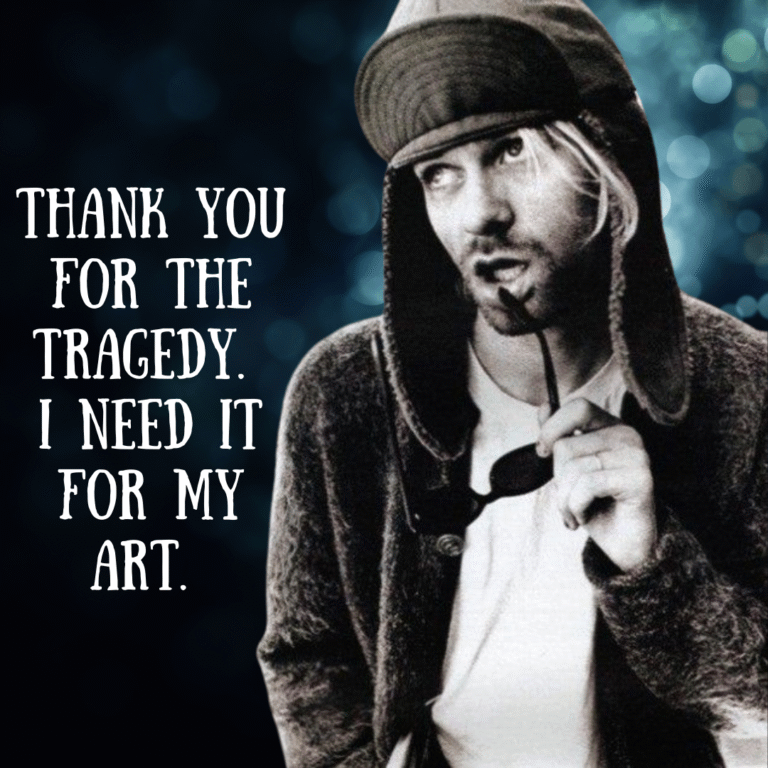
Thank you for the tragedy. I need it for my art.

  • Post author:

This quote is attributed to the late, great, Kurt Cobain. Our worst experiences in life tend to inspire us to create our best work. Often times we find it difficult to put our feelings in words and really experience them in their raw form. This is why visual art and music can speak to us on such a deep level. What the artist is expressing resonates with us in such a way we can’t really explain. And sometimes it doesn’t have to even be “art” we see. Life in all its forms is its own canvas.

A couple of summers ago we were in Portland, Oregon before leaving to fly home. Some neighborhoods there have seen better times, to put it mildly. We were passing through a notoriously rough neighborhood. I came across a man who was lying against a building, partially on the sidewalk, zonked out, surrounded by syringes and other debris. This scene wasn’t out of the ordinary for the area. There was something beautiful about it, though. It was overcast and all the colors surrounding the man were cool in color. It felt damp, dreary and hopeless.

Greys and blues draped his background, while he nodded out, slightly leaning forward. The sleeves on his black button-down shirt were rolled up, and his legs dressed in his tattered blue jeans laid sprawled out in front of him. As I went by him, I felt the desperation and need for escape he must have felt. He didn’t attempt to hide getting high and he laid there vulnerable to the world in his altered state. Yet for him, that moment he was experiencing was probably something completely different than what we saw.

One block over, a (presumptively) suburban looking mother was taking pictures of her daughters or daughter and her friends with the Portland skyline in the background. They were well-dressed, laughing and enjoying being teenagers. They didn’t seem fazed by the seedy neighborhood or despair around them. They continued to pose as we passed by them, oblivious to the decay and despondent vibes that plagued this neighborhood. As someone who is mindful of her surroundings and often anticipating movements from others, I can tell you that these women where not at all. Which also left them vulnerable to potential threats around them.

To me these stark differences were fascinating. While we may take different paths in life, we are all human. We all have things we deal with. And while on the outside our lives might look different, what we experience from art touches us in such a raw way because, in some ways, we are all the same.

What allows us to connect to others in such a deep and meaningful way, is the fact that we can all relate to hardships and tragedies. Art gives those experiences a voice that can make us feel less alone and united in the human experience.


Continue ReadingThank you for the tragedy. I need it for my art.

I failed. Good. Now go fail again.

  • Post author:

In Game of Thrones, Davos Seaworth talks to Jon Snow after he was murdered and came back to life. Jon says he tried to do what he thought was right and he was murdered for it. He doesn’t understand why he was brought back to life.

Davos tells him that it doesn’t matter why he came back. He expresses to Jon that he has to keep fighting and try to clean up as much of the shit as he can. To this Jon declares that he doesn’t know how to do that and because he thought he did, and he failed.

Davos says, “Good. Now go fail again.”

https://www.youtube.com/watch?v=xM8pXG7mkzw

The only failure in life is refusing to try. It’s falling down and refusing to get back up. Things are only impossible when you refuse to try.

For perspective, how would our world be different if the people below refused to fail?

  • Thomas Edison – He was told by his teachers that he was ‘too stupid to learn anything’. He went on to hold more than 1,000 patents, including the phonograph and practical electric lamp.
  • Steven Spielberg – He was rejected twice by University of Southern California’s School of Cinematic Arts. He went on to win five Academy Awards.
  • Albert Einstein – He didn’t speak until age four and couldn’t read until age seven. He was considered to be mentally handicapped. He not only changed the way we perceive physics; he won a Nobel Prize.
  • Stephen King – His first book, Carrie, was rejected by publishers 30 times. Frustrated, he threw the manuscript into the trash. His wife retrieved it, asking him to try one more time. He did and it was his first book deal.
  • Sylvester Stallone – He was rejected by talent scouts over 1,500 times. When he was writing Rocky, he was so broke he had to sell his dog to keep the electricity on.
  • Oprah – She was told she was unfit for television and fired from her first job.
  • Katy Perry – Her first album sold a mere 200 copies before the record label went out of business. After that she was dropped by two record labels. Ten years later she released I Kissed a Girl, and her career took off.
  • Michael Jordan – He was cut from his high school basketball team for lack of talent.
  • Howard Schultz – When developing Starbucks, he was turned down by banks 242 times.
  • Walt Disney – His idea for a theme park was trashed 302 times.
Continue ReadingI failed. Good. Now go fail again.

You’ll have bad times, but it’ll always wake you up to the good stuff you weren’t paying attention to.

  • Post author:

It is human nature to forget the good things and focus on the bad things when they happen. In an earlier post, I wrote about how we are too prone to engrave our trials in marble and write our blessings in sand. You can read it in full here.

While we may wish that we didn’t have to go through tough times, they are essential for our growth. And life will continuously test us and throw us curve balls. Without struggles or challenges we wouldn’t be able to experience triumph. Just like we can’t experience happiness without knowing sadness.

Negativity Bias

As we go through life, we often ignore all the good around us. Whether it’s the simple basic needs that we have, such as food and shelter, or even cherishing an accomplishment like a promotion, we tend to focus on our struggles and challenges.

When someone asks you about your day, think about what your first answer is? Do you generally think of the mishaps, like the time you tripped in front of your boss, the coffee that got cold, and that one negative comment on social media? Or do you naturally pivot to the fact that you have a job, you had a delicious bagel, and the 100s of positive comments on social media?

We human beings are wired with what is called the negativity bias. This is an innate instinct to focus on the negative around us so that we can quickly identify threats and survive. When our ancestors heard a strange sound that could be a tiger or just an innocent bird, they had to assume the worst. Their negativity bias protected them and helped them survive.

While this evolutionary instinct served us well back in the day, in our modern world where our lives aren’t exactly in constant danger, the negativity bias tends to distract us from the good in our lives to focus on the bad. Sometimes we need a push, occasionally in the form of a challenge, to open our eyes and see all the good around us.

Our Struggles are a Blessing

Through our hardships, we can learn to value and appreciate our blessings even more. With no dark, there is no light. With no night, there is no day. Similarly, without any pain, we wouldn’t know what joy is.

Hardships Can Uncover Goodness We Aren’t Aware Of

Recently, I received some hate comments online. While I am pretty immune to what people say online, these comments were incredibly hurtful, and I didn’t expect them at all. However, when I expressed my experience, numerous people who I had no idea appreciated my content reached out to me, sharing love and gratitude for what I do.

This is a perfect example of how a hardship can reveal existing blessings that you didn’t even know about earlier!

Gratitude

In order to truly be happy, we must take stock of everything we have in the present moment. We are blessed with so much, and the more we appreciate it, the more we will begin to notice it and feel better. Practice gratitude on a daily basis. Tell your loved ones how grateful you are for them. Wake up and express gratitude for the gift of a new day.

This gratitude will not only help you in tough times, but rather tough times will also help you be more grateful. For example, only when you have a headache do you realize how blissful it is to have a pain-free body! That’s when you can be grateful for all the times your head didn’t hurt.

We all face hardships and challenges. Rather than run away from them or fear them, allow them to show you the good in your life. Reflect on your blessings. By making this a daily habit, you will inevitably realize there is so much to be thankful and grateful for.

Continue ReadingYou’ll have bad times, but it’ll always wake you up to the good stuff you weren’t paying attention to.

You have to let it all go, Neo – fear, doubt, and disbelief. Free your mind!

  • Post author:

In The Matrix, Morpheus implores Neo to free his mind. All of the things he believed about the world around him has to be unlearned. For him to fully comprehend the truth, he has to abandon all that he believes.

The deeper point in Morpheus’s words is that we should question everything. No matter how much we think we know, there is always something to learn.

Strong held beliefs can get in the way of us learning. When we are inflexible about what we believe, we don’t challenge our thoughts. It’s actually a defense mechanism that our egos use to protect our self-image. If what we believe is questioned, we have an innate need to “protect” our position and we are immovable. We lack curiosity about a new perspective or point of view because we feel like it is an attack on us.

Some people I know get very defensive when you even hint at challenging what they believe. They refuse to have an open debate about it because they don’t want any holes poked in what they believe. And this is where confirmation bias can come in. Instead of listening to someone else’s opinion that might challenge what they believe, they ignore it because contradicts their existing views. They may also interpret anything that is said to conform to their world view – even if it doesn’t make sense.

Personally, I like my beliefs being challenged. Some of the people closest to me see things radically different than me, and it’s awesome. My favorite philosophical conversations are with people who have opposing views. I’m curious about everything and one of two things will happen after that conversation:

1.) I will feel more confident in what I believe or

2.) I will learn something new or discover a new perspective that will intrigue me.

I will investigate more and do my own research to understand it better. The truth is, you will never learn something from those who agree with you. The worst thing you can do, in my opinion, is create an echo chamber around yourself.

Continue ReadingYou have to let it all go, Neo – fear, doubt, and disbelief. Free your mind!

You only win if you aren’t afraid to lose.

  • Post author:

Over the past few decades, the fear of failure, or atychiphobia, has become more prevalent throughout society. This fear is often rooted in perfectionism, and it leads people to doubt their abilities and avoid trying. The truth is, we must overcome the fear of failure if we want to be successful.

In this post, we will look at the reasons we fear failure, why the fear of failure is damaging, and some ways we can go about overcoming our fear of failure.

Why Do We Fear Failure?

While everyone who fears failure has a different reason behind their fear, there are a few main reasons that we develop an aversion to failing.

Extreme Criticism as a Child

In today’s world, we expect a lot from children. We expect perfect grades, perfect manners, perfect athletic abilities, etc. Overall, we tend to make them feel that failure isn’t an option, and that expectation leads to fearing failure even into their adult lives.

Unmanaged Anxiety

When a person with high anxiety doesn’t find ways to manage their anxiety, it can become more and more difficult for that person to do the things that cause them anxiety. The fear of failure can stem directly from a person’s unmanaged anxiety.

Perfectionism

As mentioned above, this fear is often rooted in perfectionism. Perfectionists fear being seen as less than perfect and failure actively goes against that portrayal, so they avoid failure to maintain the illusion of perfection.

Why is it Damaging to Fear Failure?

While it may seem like a good thing to not fail, the constant fear of failure is very damaging to a person’s life. Here are just a few of the consequences:

Underachievement

When a person fears failure, they tend to underachieve because they avoid challenging themselves. For example, they might stay in the same job for their entire career because trying to reach the next level up poses the risk of failing.

Missed Opportunities

Similarly, those who fear failing tend to miss great opportunities in life because they are scared it won’t work out in the end. This leads them to miss out on improving themselves, making new relationships, and advancing in their careers.

Less Creativity

People who actively avoid failure also tend to be less creative. To keep themselves from making a mistake, they follow rules and guidelines very closely rather than making adjustments to improve their work.

How to Overcome Fear of Failure

Redefine Failure

If you fear failure, typically you have an unrealistic definition of what failure actually is. To overcome your fear, you need to change your thinking. Commit yourself to viewing failure as an opportunity to grow, learn, gain experience and thrive. Remind yourself that failure isn’t permanent, and you can always improve in the future.

Focus on Your Strengths

Acknowledging your strengths can give you more self-confidence and help you use your strengths to address your fears. Knowing that you are capable and ready to take on challenges will make you feel more ready to confront the possibility of failure.

Plan to Fail

Make yourself fail. In other words, start a project with the intention of failing. Allowing yourself to fail can demonstrate that failure really isn’t something to fear. The more you fail, the more you’ll be okay with making mistakes and accepting challenges.

Make Challenges Less Daunting

If you find yourself putting off a project because you fear failing, break the project up into smaller, easier steps. Seeing a larger goal in smaller pieces can feel more manageable and you’ll be less likely to shy away from the challenge. When the fear of failure is holding you back, use these four steps to overcome your fear and begin living the life you deserve.

Continue ReadingYou only win if you aren’t afraid to lose.

Maybe we have to break ourselves to make something better out of ourselves.

  • Post author:

Have you ever felt broken? Like everything seems to be pushing you a little too much, life is stretching you, and you don’t know what’s next?

If you feel like that, you’re not alone. We all go through tough times where life pushes us to our max. But the good news is that this can be a time of immense growth. It can be an opportunity to improve yourself. As a matter of fact, when I look back to my worst times in life, the lessons I learned and the wisdom I gained, propelled me to a much better place.

Builds Character

When you face difficulties and challenges, you get to choose what mindset you adopt. You can have a growth mindset, where you see this as an opportunity to improve and you are grateful for the challenge. Or, you can adopt a fixed mindset, where you step into victim mode. You can complain, have self-pity, blame the situation, and end up staying stuck.

When your plans are broken and you face a roadblock, you get the chance to build your growth mindset and become stronger. You are able to reassess and recommit to your goals. You build confidence and perseverance, which helps build your character.

Unexpected Guidance

When you face struggles and challenges, you have to dip into resources you may not have known you had. For example, you might ask family or friends for help. Or, you might hire a coach. You may even tap into your own inner wisdom that you weren’t aware of earlier. Reaching a stage of being broken can help you access sources of guidance that can help you improve yourself.

Increases Self-Efficacy

Self-efficacy is your belief in yourself to be able to overcome obstacles. It’s the confidence one has in their ability to succeed. When you face hardships, you are stretched beyond your comfort zones. When you reach a breaking point and you move past it, you build that confidence in yourself that you can truly face anything. That is an extremely powerful self-image, rendering you limitless. The next time you face a challenge, you’ll have the confidence that you can easily overcome it because you have overcome countless challenges earlier.

Reframe Stress

What is the first thought that comes to mind when you think of stress? If you are like most people, you associate stress with negative emotions. It’s difficult, exhausting, and something to be avoided. Seeing stress as a threat causes your body to enter the fight or flight response, releasing cortisol and increasing fear.

However, what if you saw stress as a positive emotion? What challenges would you then face? What scary life-changing decisions would you make?

When you are presented with a setback and feel broken, you can practice looking at stress as a challenge rather than as a threat. When you do this, your body feels more focused instead of fearful, and you get a boost of energy that you can use to your advantage. So, the next time you are faced with a problem, try to reframe it as a challenge rather than a threat.

A great example of breaking yourself to make yourself is found in athletes. Professional athletes sacrifice hours of their day to train, pushing their body past all limits, adhering to strict diets, and living in accordance to carefully planned routines for training, sleep, and meals. But by pushing themselves hard and stretching their limits, they make themselves.

When you feel pushed past what you thought you could handle, remember, this is a golden opportunity to improve yourself. You get to create a new version of you who is stronger, wiser, and more resilient. So, embrace those moments of brokenness, and get back up again.

Continue ReadingMaybe we have to break ourselves to make something better out of ourselves.

We delight in the beauty of the butterfly, but rarely admit the changes it has gone through to achieve that beauty.

  • Post author:

It’s easy to look at people who appear to be happy and successful and assume that they have always had an easy life. It might seem like everything they want just comes to them effortlessly, and that they have never had to struggle or strain to get to where they are today.

However, if you were to dig into the personal history of many of these people, you might be surprised by what you find there. Some of the most successful and influential people in the world have had to fight through inner and outer battles that were filled with heartache, terror, and chronic self-doubt. Some of them have had to overcome life-threatening challenges. Some of them had no supporters in their life and had to carry on alone. Plenty of them came close to giving up. Many of them even feared that they didn’t have the strength to make it through, but somehow, they managed to persevere.

There are also some people who are born into opulence, who have success practically handed to them on a silver platter. But allowing yourself to feel envious or bitter about that will only hurt you. The more you resent the success of others, no matter how it was attained, you will move yourself further away from success, rather than closer to it.

A more empowering perspective is to remove your focus from the journeys of others, and instead rejoice in the beauty and value of every stage of your own personal journey. Allow yourself to feel a sense of satisfaction about everything you have managed to overcome up until now. Express genuine appreciation and gratitude about where you are today and look forward to the future with a sense of hope and optimism.

Even if you may sometimes feel like a caterpillar that is surrounded by beautiful butterflies, remind yourself that caterpillars are no less beautiful, valuable, or worthy than butterflies. In fact, caterpillars could even be considered more inspirational than butterflies, simply because they have not yet tapped their full potential. Butterflies have already become everything they can be, and while they are beautiful to behold, their journey is nearly at its end. If you are in the caterpillar stage, your journey has just begun. Allow yourself to feel excited and glad about that.

And like the caterpillar, if you happen to be in the chrysalis stage where your dreams and goals seem to be at a standstill, embrace this stage of the journey as well. Say to yourself often, “I am becoming the best me that I can be, and I am worth the wait.”

Feel a sense of anticipation and excitement about this phase of your journey, because once your metamorphosis is complete, life will begin flowing new ideas and opportunities your way and you will be thrust into a flurry of activity. Trying to hurry this process along will be counterproductive because your inner transformation will not be complete, so you won’t be quite ready to handle all of the new changes coming your way.

Instead, breathe deeply, enjoy your current chapter, settle fully into the stillness, and allow your energy to gather and expand deep in your belly. Before too long, your beautiful new wings will unfold, and you will be ready to take flight.

Continue ReadingWe delight in the beauty of the butterfly, but rarely admit the changes it has gone through to achieve that beauty.

Expect nothing but the changes.

  • Post author:

As they say, change is the only constant in life. But getting comfortable with change? That is an entire different story, isn’t it?

We tend to stick to old patterns and routines because they make us feel comfortable. Even if they no longer serve us, we often stick with them because they are known.

While change can be stressful in the immediate, long term it can be opportunity or a blessing in disguise.

Here are some ways to help you navigate change:

Embrace Change and Uncertainty

When change comes along, we often resist because we feel like we’ve lost control in some capacity. It’s looked upon as a major disruption when a better way to view it is as an opportunity. While it is human nature to want to resist, try to embrace the new possibilities of change.

Try seeing change and uncertainty from a different perspective. Instead of asking why this is happening to you, ask yourself why this is happening for you. What do you need to learn from this? What new opportunities or adventures are available to you now?

When you embrace change, you evolve as a person. It helps you handle issues that arise by surprise, and you learn how to become more resilient. You learn more about yourself and the world around you.   

Have an Open Mind

Have a mind that is open to everything and attached to nothing. When we come from a place of abundance and excitement about new things, the universe responds to us in kind. When you refuse to accept change, your options dwindle, and you stay stagnant.

If this seems scary at first, you’re not alone. Our brains are wired to protect and keep us from perceived harm. And to some of us, change from how things have been for a long time can feel like it will be harmful to us.

Let Go of What You Fear to Lose

In a previous post, I talked about how important it is to train yourself to let go of everything you fear to lose. Remember, eighty percent of the choices we make are based on fear. Often times we don’t really choose what we want – we choose what we think is the safest.

Get into the habit of digging deep to understand what your fears are. Then ask yourself what the worst possible outcome is. Then game plan for it. What you will likely realize is that if the worst-case scenario actually happens, you may be deeply affected by it, but you will come out the other side okay. Even if it takes a while.

Fear has a way of gripping us so tightly that we forget how resilient we naturally are. We forget that while we might not like a particular outcome if it happens, we will be okay in the end. Afterall, we have all survived 100% of the things that have happened to us already.

Continue ReadingExpect nothing but the changes.