In Game of Thrones, Sansa remarks to her sister, Arya, that “the lone wolf dies but the pack survives” when talking about Winter. It is also said several times in the books, one time being a conversation between their father Ned, and Arya.
The meaning behind this quote is that when Winter comes, the people of Winterfell must protect each other, survive, and share their strengths to make it through.
If you’re like me, you have a hard time not wanting to face things alone. When I am going through something, I literally have to force myself out of my comfort zone and ask for help or support when I need it. I have this idea in my head that if I need something, I am inconveniencing someone else by asking. As comfortable as it can be to go it alone, it can be incredibly lonely at times.
The truth is, we need people. We need support from others, and it makes us feel good to be there to support others during difficult times.
The human brain is hardwired to form groups and tribes for self-preservation. Years ago, if a person left their group they would likely die. They could have been eaten by a tiger or experienced some other misfortune on their journey alone. But when you had a tribe, staying alive wasn’t just an individual’s responsibility. All members worked to ensure the safety of their people and because of that their chances of surviving were higher.
In modern times, this applies to our emotional and mental health. It’s important to surround yourself with people who will be there for you and vice versa. For me, I feel a lot of relief just telling someone else out loud what is going on with me. I don’t necessarily need advice. Sometimes just confiding my struggles with one other soul makes all the difference.
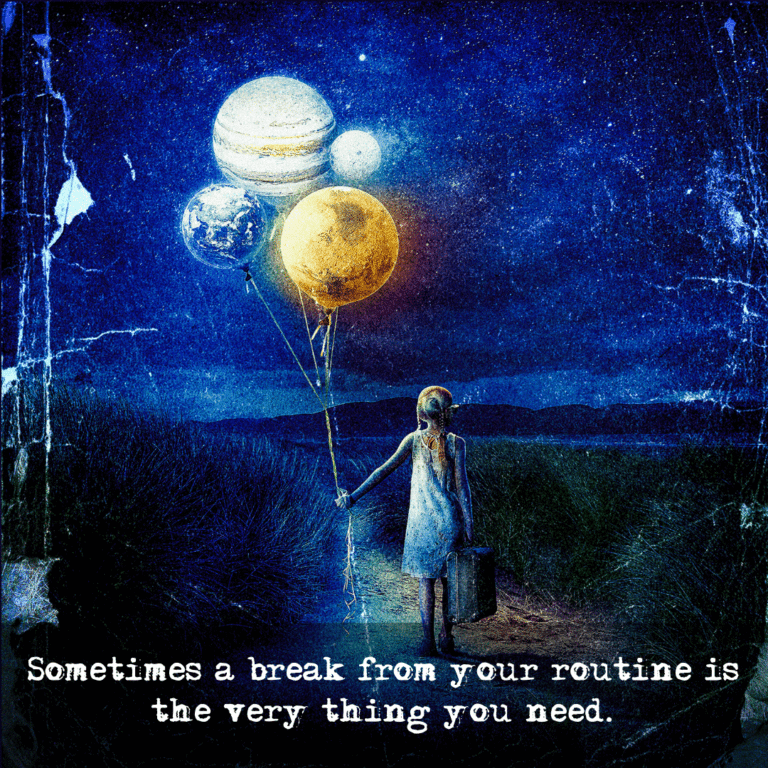
Routines can be a great help when it comes to managing your daily life. They allow you to plan and prepare for the days ahead, and therefore minimize the stress and confusion that can result from disorganization. The downside to routines is that a regimented life will usually start to feel confining at some point. Boredom sets in, and you start feeling irritable and restless.
Taking a break from your routine every now and then can bring a welcome sense of freedom and fun back into your life. Even very small changes can be invigorating, such as rearranging your furniture, or starting a new fitness program.
Ideally, you might start by thinking about the areas of your life that feel a bit flat and uninteresting, and come up with ways to make them more fun and inspiring. For example, if you are in the habit of carefully prepping meals every week and you tend to eat the same foods repetitively, research some new recipes, or try a restaurant where you have not eaten before, or even try a meal delivery service for a week.
If you tend to follow the same waking and sleeping schedule every day, set your alarm to wake up earlier to catch the sunrise, or stay up a bit later to gaze at the stars. Rather than watching the same programming on television week after week, seek out an interesting documentary or a musical concert to enjoy.
Take in some new scenery by deliberately choosing a new route when driving to your destination, or even plan a short road trip with a friend. Set aside a few hours each week to broaden your experiences by visiting museums, libraries, public gardens and parks. Get your body moving on some new hiking trails, treat yourself to a spa visit or get a massage once a month, or awaken your creativity with a new hobby.
Another important routine that you may wish to change is your habit of thought. If you find that you are often stuck in the cycle of complaining or criticizing yourself or others, choose a new positive thought to practice, such as, “I choose to focus on the good today.”
When you first begin changing your routines, you might feel a bit unsettled or displaced. You may have become so comfortable in your routines that you find yourself resisting any kind of change. If you push through that initial resistance, you will likely come to love the feeling of enthusiasm that results from trying new things.
While you may decide to keep certain routines in place simply because they help your life run more smoothly, you will also quickly become committed to releasing unnecessary routines wherever possible and embracing change in the areas that have become dull and stagnant.
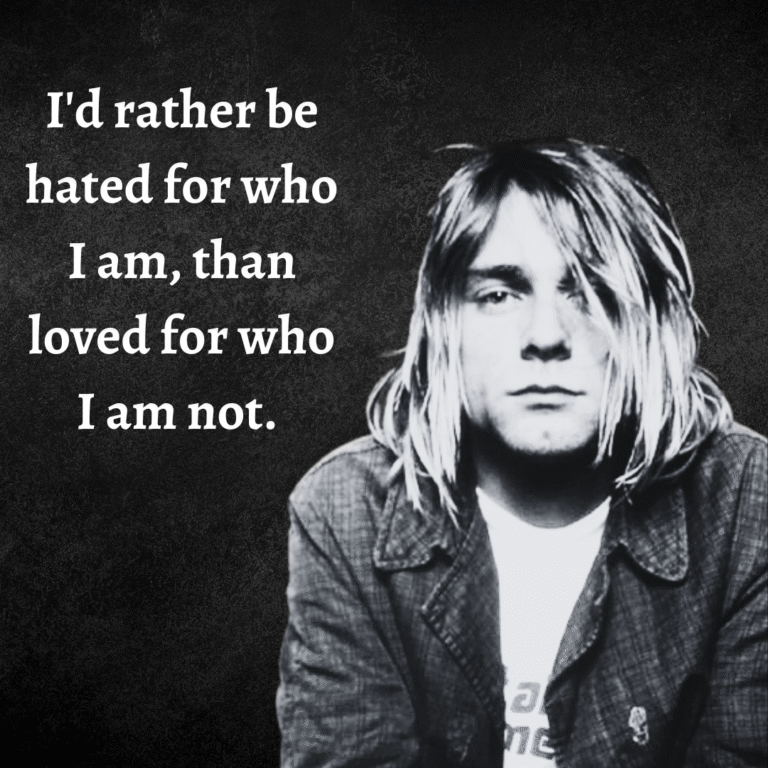
This quote is often attributed to Kurt Cobain, who was the front man for the grunge band Nirvana in the late 80s/early 90’s. However, a variation of it was published in the book Autumn Leaves by André Gide in 1950.
There are always going to be haters who want to drag you down. In earlier posts I wrote about how when my husband and I first started our YouTube channel (unrelated to this blog) we got some haters. At first their comments bothered me, and now it’s just amusing. We get some good laughs. It’s easy for these people to spew their negativity in the comments section when they are hiding behind a screen.
Don’t ever lose yourself in the quest to satisfy people. You will never be able to please everyone, and people are always going to have something negative to say about you.
But back to Kurt and Nirvana. The interesting thing about the band was that they had a sound unlike anything else that had been heard in the business until that point. Rock music was transitioning from hair metal and a new sound of grunge was emanating from Seattle. In 1989, Nirvana released an album titled Bleach. Many people working in the music industry were blown away by this new sound. They all predicted that this new music would change the entire landscape of rock and roll – and it did.
For many people, their first exposure to Nirvana was probably in 1991 when their album Nevermind was released. The song, Smells Like Teen Spirit became a hit overnight and Nirvana became the new face of rock. This kind of music resonated with mainstream America and didn’t stop until Kurt’s death in 1994.
I remember seeing the music video for the first time and falling in love with this kind of music.
Nirvana paved the way for other great grunge bands like Alice In Chains, Soundgarden and Pearl Jam. These bands also became popular quickly.
Nirvana wasn’t afraid to go against the grain and be different. They didn’t care about being famous like people do today. I have a feeling if their sound hadn’t resonated with the world, they would have been content making a living playing locally around Seattle.
In the end, you are better off just being you. There is nothing that is worth losing yourself over, just to feel accepted and loved. Stay true to yourself and the right people will come into your life and love you for who you are.
I once had a professor who was a stickler for the tiniest of things. He took pride in telling his students about their shortcomings in the class. So, when our first writing assignment came along, I was extremely excited. I thought this would be a chance to show my improvements as a writer. As he approached me, I could see a big zero and the word ‘plagiarism’ written across the top when my paper in red ink. In a note on the side, he wrote what I had plagiarized. What he was saying I plagiarized were the words, “In the town of…”. I was mortified and furious.
Calling out a student for wording something in a way that is rather common for the context of the paper, was rather ridiculous. However, after that experience, I made sure that my words, unless quoting directly, were always original. I even bought a plagiarism tool to help me meet that expectation. As much as I didn’t like my professor, he made me take action to never be in that position again. In short, he taught me a valuable lesson.
People of all kinds can be our most excellent teachers. And just as you can learn something from humans who are good and kind, you can learn something from horrible ones. Undoubtedly, everyone you meet has something to teach you if you’re willing to let your guard down and learn.
Here are some things to consider when given the opportunity to gain knowledge.
What’s the story?
People are fascinating, and though not everyone you learn from will be awful, figuring out a person’s backstory can help you define their motives. Additionally, learning about this person can give you insight if you have differing opinions. We all have different backgrounds and understanding someone else’s will open your eyes to new views.
Listen
Listening can be challenging, especially in sticky situations where personalities clash. But actively tuning in to what another person has to say is crucial in the learning process. Doing this helps you communicate your ideas and builds a bond – even if you don’t agree with attitudes or opinions.
Find peace
When I went through my learning experience with my professor, it took me a while to let go of the anger. I wanted to contest his decision. But because I understood his personality and some of his reasoning, I knew I wouldn’t find success in pleading my case. It wasn’t until I found peace with the situation that I made progress. Finding peace is difficult, but the lessons will follow after the calm rushes in. And the truth is, now when I think about this life lesson, I smile remembering what he taught me. It only helped me improve as a student and a writer, so I am grateful.
Actively use the lesson
After a lesson is learned, don’t hesitate to use it for all it’s worth. I use the lesson I learned from my demanding professor every day. Though some lessons might not be that significant, they’re still worth keeping close. You never know when you’ll need to plant a seed or help yourself in a tough spot.
Everyone has something to teach, whether it’s a person you are fond of or someone who clashes with your personality. It could be lessons you learn from observation or lessons that blatantly put you in a position to learn. In either situation, it’s an opportunity to grow and become a better version of yourself.
I love this scene in Breaking Bad when Walter White says this quote to his wife, Skyler. It completely takes her by surprise. She has just told him that if he is in danger from his business dealings with Gus, they should go to the police. She is adamant and Walter is not having it. She goes on to say if they have to worry about him getting shot when he opens his front door, they need to do it because he isn’t a hardened criminal. He is in over his head. She tells him that it’s the truth, and Walter says it isn’t.
Walter likes being a criminal. And Skyler insists that he isn’t one that he needs to admit he’s in danger. And Walter loses it. Maybe it is just me, but I was so proud of Walter for what he said to her when he says, “You clearly don’t know who you’re talking to, so let me clue you in. I am not in danger, Skyler. I am the danger. A guy opens his door and gets shot, and you think that of me? No! I am the one who knocks!”
Clearly Walt is upset that Skyler didn’t see him as the threat that he was to others. Every man wants to be admired and respected by their wife. Walter sheds his meek persona when he gets into the meth business. He is doing something dangerous, and it kills him that his wife sees him as the old version of himself.
He likes the confidence he has being “Heisenberg”. This new version of himself makes him feel alive. And he just wants his wife to appreciate him.
The lesson here is that sometimes people are not going to see us as we want them to. No matter how much we show that we are different, sometimes they just don’t want to see it. Skyler didn’t want to see Walt as the danger. It terrified her.
Everyone faces challenges in life, and sometimes they can be so overwhelming and taxing that we doubt our own ability to make it through. You can probably recall at least a few big hurdles that you have had to overcome in your own life that may have tested your endurance and patience far beyond anything you had gone through before.
While you probably sought support and guidance from the people who are closest to you, such as your family and friends, you may also have found yourself looking for encouragement from other people who have gone through something similar. Maybe you searched for stories like yours on the internet, or you joined a support group to connect with others who were facing similar challenges.
These connections can often boost your courage and determination to tap into your inner strength reserves much more than you would have on your own. The success of others quickly becomes your own success too, simply because they helped you to remember that you already have within you whatever you need to overcome any challenges.
However, you may be surprised to discover that you can also serve as your own best source of inspiration, even if you can’t seem to find that encouragement from other people. One good way to do this is by engaging in a little bit of make believe.
Imagine that you have just overcome your biggest challenge and you are feeling extremely relieved and proud of yourself for what you have accomplished. Now you are going to write your story and share it with the world so that you can inspire others.
Use a notebook or journal, or a document on your computer, or even record yourself speaking as if you were a guest on a podcast. Start at the beginning and tell your story. Where did you start, and how did the challenge first appear? How did you feel as you faced this challenge? Did you experience any self-doubt or worry that the problem was insurmountable? What finally convinced you that you could overcome it? What did you do to push through to the other side? How has the experience changed you and made you believe in yourself even more than you did before?
Write your story as you would like it to be, a compelling drama that portrays you as the hero or heroine, and imagine your readers or listeners being enthralled and inspired by your journey. Then read this tale to yourself out loud every day, even multiple times a day.
You will find that it inspires you just as much as, or even more than hearing about someone else’s triumphs in life. It will awaken your own inner strength and empowerment so that you end up living your story just as you have written it. Even though some of the details might differ, the ending of the story will be the same, which is you powerfully overcoming any challenge that faces you.
Once your fictional story has actually become a reality, consider sharing it with the world for real, even if it’s just a simple blog post or a podcast segment. Your personal victory just might be the very thing that someone else is desperately wishing for to help them persevere through their own challenge.
I selected this quote from Breaking Benjamin’s song, Dairy of Jane, which was released in 2006. It’s an old saying, though. And throughout history, many have remarked that there seems to be a fine line between love and hate.
But is there really? Surprisingly, the answer is yes. Some of the same nervous circuits in the brain responsible for hate are the same that are activated during love.
For starters, love and hate are both intense emotions. I know when I have been really hurt by someone I love, I have felt hate towards them in the moment. And it quickly fades away after the pain subsides. The intensity and duration of these emotions will vary from person to person. For me, it’s actually hard to stay mad at someone for too long. I’m the kind of person who, while still being mad at you, will think of something randomly that’s hilarious, go to call you and then stop because I have to remind myself I am mad at you.
While your individual mileage may vary, both emotions are strong in that when you love someone, you don’t say, “I love you a little bit”. Or when you feel hate towards them, you don’t say, “You know, I kind of hate you”. You feel it strong. And these intense emotions can be tricky because when you feel them, it can be hard to remain objective about the relationship.
When it comes to feeling love, we are more vulnerable to feeling hurt if their love isn’t reciprocated the same way. Or they do something to hurt you, whether it’s intentional or not. The sting from that kind of pain can quickly change your feelings for them from love to hate.
When you love someone, sometimes you find yourself putting up with all kinds of things you wouldn’t ordinarily put up with. Or perhaps you have chosen to move across the country for them to a place you don’t really like, but he or she wants to be there. We will move mountains for love.
If you hate someone enough, they could go over and beyond to right a wrong and it doesn’t matter to you. Both emotions cause us to go in extremes, and it seems like it can change in an instant.
What Makes You More Vulnerable to Cross the Line From Love to Hate
There are a few feelings that are apt to cause you to cross the line between love and hate. By being mindful of these things, you can temper your emotions.
Rumination
When we dwell on past hurts, we are inching closer to that fine line. We may find ourselves wondering why that person hurt us over and over again. The more you ruminate and fixate on it, you will seek answers in regular conversation. If your partner doesn’t pick up on it or says something insensitive, you may feel hatred towards them for not getting how much they hurt you. If you have chosen to stay and work through the hurt, make sure it is fully resolved before moving forward.
Jealousy
Jealously can rear its head when we are feeling insecure. If we suffer from low self-esteem, we may feel like we aren’t worthy of being loved back. To protect our egos, we prepare ourselves for the worst outcome. That is why we start reading too much into innocuous things, like the way your boyfriend smiled at the barista at Starbucks. It likely was him just being nice, but perhaps you worry that he’s interested in her. Your love may turn to hate because you feel so wounded by “his behavior.”
Possessiveness
Possessiveness is a natural outgrowth of insecurity. We get possessive when we seek to control someone else, so that we feel at ease. It’s ineffective and you end up pushing the other person away because they don’t want to be controlled. You might find yourself controlling where they go, who they hang out with or even manipulating situations to ensure that your partner stays away from other people. This kind of behavior has the potential for both of you to cross the line from love to hate.
How Do You Avoid a Love/Hate Relationship?
The most effective way to avoid this dynamic is work on your self-esteem and understand your attachment style. Knowing how you attach to others can help you understand your own vulnerabilities in relationships. It will give you a map and compass on what you need to do to become more emotionally independent. I wrote a post a couple of years ago all about attachment styles and how you can break unhealthy patterns. You can check it out here.
In addition, it is helpful to understand what a healthy relationship really looks like. Unfortunately, our culture is constantly altering the image of how a good relationship should be and it doesn’t help that we have less examples around us to show us.
I also wrote a post a couple of years ago going into detail about the ten components of a healthy relationship. I’ve listed the ten traits below, but you can read in depth about each here.
You can be happy and whole on your own.
There is trust on both sides.
Each person is authentic, and they love and respect who each other is at their core.
You both know how to effectively communicate.
Each person takes personal responsibility for their own feelings, actions and thoughts.
You treat each other with respect.
You both welcome boundaries and aren’t offended by each other setting them.
Each partner makes the relationship a priority and actively put forth effort.
You both know how to resolve conflict.
Both show gratitude and appreciation for each other.
Life is a constant cycle of ebb and flow. There are periods of time when abundance and goodness are flowing freely, and also periods when things are fading and disappearing from your life, such as relationships, jobs, and money. These periods of ebb can be frightening because it often feels like you have been cut off from your source of good. You may wonder if scarcity will become a permanent fixture in your life, so you hold your breath, anxiously waiting for the next cycle of flow to appear.
But just like ocean waves, abundance never stops flowing. There is always another wave of abundance and new beginnings on the way. Even as you are making your way through loss and transition, there are fresh new ideas, exciting opportunities, and deeper connections already making their way to you.
Rather than fearing periods of ebb, it may be helpful to see them as a natural pause in the flow of abundance, much like the pause between each inhale and exhale. Just as you don’t worry about your ability to take your next breath, you can also train your mind to trust that your next inflow of goodness will be just as natural and effortless.
Spend a few minutes each day appreciating the natural cycle of ebb and flow in your life and the world around you. Notice the way nature exemplifies this cycle beautifully. The seasons come and go, and nature easily demonstrates the wisdom of releasing the old to make way for the fresh and new. Think about your previous ebb and flow cycles, and how you were able to allow something much more meaningful to blossom in your life once you let go and surrendered that which was no longer serving you.
Affirm to yourself that all is well, even when things are changing, and uncertainty is knocking on your door. Breathe deeply and remind yourself that this is just another cycle of ebb, but there is never a reason to fear because the next cycle of flow is already on the way.
Allow yourself to grieve the loss of anyone or anything that is transitioning out of your experience. Be fully present with any feelings of sadness or emptiness that arise. Appreciate and honor those feelings as a normal part of human experience.
Then begin looking forward with anticipation to the next inflow of abundance. Say to yourself, “I let go of the past and I create space for the goodness that is on the way to me now.” You can even clarify your ideas of the goodness you would like to receive next, such as a wonderful new job, partner, or opportunity. Or simply stay open to all forms of goodness, in all areas of your life.
Remaining relaxed and detached about the cycles of ebb and flow in your life will help you to keep your balance no matter what is happening around you. You will be able to endure your moments of transition with grace and calm, and enjoy the moments when goodness is flowing abundantly to you, knowing that both are a necessary part of the cycle.
Thanks for coming to Mindset Made Better. If you found this post helpful, consider signing up for our newsletter. I will never share your information. We’ll send emails a few times a week with new posts, featured videos and resources that will help make your mindset better.