A fitting quote coined by Stephen King; it illustrates the human condition. When something horrific happens, we find it hard to comprehend how someone could have shot up a festival or school, or how this church going family man could have killed his wife. But the reality is, as humans, we are capable of anything. Some people are just wired wrong and commit horrendous acts of violence. Then there are regular people who have untreated mental issues or are on some serious medications that shouldn’t be combined and do things they could never imagine doing. These are more the outliers, but there are things inside all of us that are very real. We all have darkness and light. Let’s take a look at where this applies to most of us.
Ghosts and monsters of our past can haunt us for our entire life. We see this in how we interact with the world. Sometimes we keep replaying old tapes of how we were treated as kids, what we believe about ourselves or we’re still in survival mode as we replay a scary trauma that happened to us. These tapes are sneaky, too, because we don’t even realize how much they can dominate our thinking and world view until we’ve been doing it for years.
What causes us to stay stuck in this pattern is not integrating our traumas or our struggles. And we don’t integrate them because we simply don’t know how to do it. If you have been through a trauma, finding a therapist to help you sort out your feelings and integrate what happened is so important. There are many services that can help people with this, too, if going to a therapist is cost prohibitive.
When it comes to our ineffective ways of thinking, it comes down to being mindful of when you are thinking that way. Then you have to challenge that thought.
Here’s an example that I struggle with myself. I often feel like I need to take responsibility for other people and make sure they are okay, have what they need, etc. sometimes at the expense of myself. I’ve had to retrain my brain to slow things down and take a step back and say to myself, “Is this really my responsibility? If a friend told me this is their responsibility, what would I say?”. Sometimes I just keep going and take on the responsibility and don’t realize it fast enough. Other times I catch myself and tell myself that it is okay to not take on that responsibility because it isn’t mine to take. And if I don’t allow the other person to take responsibility for themselves then I am denying them the ability to gain mastery for themselves. And often I feel guilty about not taking on the responsibility, so I will literally unpack all the beliefs, one by one that make me feel guilty and question whether or not that is really fair. Would I think it is fair for my friend to feel this way about being responsible for something that is my responsibility? Of course not.
We all have ghost and little negative monsters that reside in us…but we also have the ability to evict them.
When you’re in a relationship with someone who is a narcissist or an abusive person, they don’t reveal themselves to be that way from the beginning. Obviously, if they did, we wouldn’t want to be with them. But over time, the layers are peeled back, and you start to see behaviors that are troubling.
In our society, especially with social media, it is so easy for all of us to present ourselves exactly how we want to be seen by the world. The reality is, if someone is not being authentic, eventually cracks will begin to form, and their true character will be revealed – good or bad.
You see it in unhealthy relationships, but you also see it in places you wouldn’t expect. When you see people pay it forward or do something nice for a stranger, they are showing their true character. If you are a kind person and you see someone who needs help, the instinct from your soul kicks in and you help them.
What secrets are in your soul you may be afraid to reveal?
Wouldn’t the world would be a better place if we approached love as a responsibility to keep another’s heart safe? We are often so consumed with what we want and need out of a relationship that we forget that we have a responsibility to our partner to provide a loving, safe place for them, too. We tend to focus on what the relationship isn’t giving us, rather than all the positive things we do experience from it.
This got me thinking about what a healthy relationship really looks like and the idea that we are always a work in progress. And as we grow from past and current relationships, we learn more about ourselves and what kind of partner is going to compliment us.
Here is a list of what components are necessary to have a healthy relationship that truly thrives:
1.) You can be happy and whole on your own.
While it is true that our partners encompass a big part of our lives, they shouldn’t be our end all be all. Their job isn’t to complete us. It’s important to have your own interests, friends and hobbies that make you happy and excited about your life. If you rely on your partner too much for your happiness, you place an unfair burden on him or her and you are creating an unhealthy dependence on the relationship. Get as healthy and happy as you can on your own and be mindful of vulnerabilities you may have that can cause you to become overdependent on your partner.
2.) There is trust on both sides.
Trust is the foundation of any relationship. If you don’t have trust, anything you try to build will be questioned at some point. This is how it looks in my marriage: my husband and I trust each other, and we respect each other’s privacy. We don’t go through each other’s phone looking for things or question each other’s intentions with how we interact with other people. I trust that we have a similar heart and core values, which brings me to #3.
3.) Each person is authentic, and they love and respect who each other is at their core.
This means that you aren’t trying to change their personality or character traits, or core values. Yes, there are always going to be little things that you wish your partner would do differently, but those are really small things. For example, my husband often leaves the pantry light on in the kitchen. It doesn’t matter the time of day or night it is. If he ventured into the pantry at any point, the light is usually left on. It has actually become endearing to me now, and I laugh and shut the light off.
At the end of the day, your partner should see all of your flaws and love you anyway. You know that your partner knows your soul and has your best interest at heart and approaches things that way. You are each other’s person. Your person is an asset to you because they know you and can point out things that you might not be seeing because you’re too close to a situation. Your partner should be a positive reinforcer in that when you lose sight of yourself, they help steer you back in the right direction. Not because it is their responsibility, but because they know who you are at your core and care about you.
4.) You both know how to effectively communicate.
Communication is more than just being able to be open and talk to each other. How you communicate is just as important.
In a healthy relationship, you can communicate without projecting onto each other, closing down, stonewalling, being passive aggressive, giving the silent treatment or blaming the other person for your feelings. You can listen to hear your partner, rather than listen to respond. Ego is removed and you aren’t thinking of all the things you want to say while they are talking or ways you can defense yourself or prove your point.
Which brings me to #5, which I believe is the most important component of all healthy relationships.
5.) Each person takes personal responsibility for their own feelings, actions and thoughts.
When you take responsibility for yourself, you own how your actions impact the relationship – both positive and negative. You understand that other people don’t make you feel a particular way. You take responsibility for how you feel regardless of what your partner says or does. It’s saying no matter what happens, you will be responsible for yourself and will always have empathy for your partner and where they are are coming from. You will respect it even if you don’t agree with it.
This doesn’t mean that you’re a doormat or don’t stand up for yourself. It means you know how to take care of yourself emotionally and mentally, soothe yourself, and respond in calm, measured fashion. When you know how to handle and take care of yourself, you don’t put the responsibility of feeling okay onto someone else. You don’t allow what someone said or did to change your emotional state.
You see, people avoid owning their own feelings and actions because it requires them to take action. Think about it. When you stop and really think about how something makes you feel, and you know that how you are feeling is your responsibility and not anyone else’s, you have to make a decision and take action.
Responding in unhealthy ways, just keeps us on a hamster wheel of denial and avoiding responsibility. It keeps us stuck.
6.) You treat each other with respect.
Many people get hung up on respect, which I totally get. I used to believe it was #1 in relationships. And it is definitely important. But what treating each other with respect really is, is a state of the relationship. It’s how you both relate to each other and just are with one another.
This is reflected in communication, as well as owning what you say and do in the relationship.
7.) You both welcome boundaries and aren’t offended by each other setting them.
Boundaries are basically our standards. It is our way of communicating what we will tolerate and what we won’t accept. This where we teach people how to treat us.
It important to be clear with yourself about what your standards are. Then you can communicate it to your partner. Too often we find ourselves in situations where we are upset because a boundary has been crossed, but we didn’t even realize it was a boundary for us until it had been crossed.
If you are still dealing with wounds you haven’t healed, be careful with boundaries. When we come from a wounded place, we might not believe that we are worth enough to adhere to our own standards for what a relationship should look like. So we may set boundaries, but are unable to enforce them. And when that happens, we are teaching the other person that we will tolerate them violating our boundaries.
8.) Each partner makes the relationship a priority and actively put forth effort.
Even when you both have hectic and busy lives; it is critical to carve out time consistently to prioritize quality time to connect. This might be a date night once a week or every other week. Make it quality time by leaving your phones behind.
Couples often lose sight of the fun, light vibe they had in the beginning of their relationship. Keep flirting and having fun with each other. Put forth more effort into your appearance like you did in the beginning.
9.) You both know how to resolve conflict.
Approach conflict as a team and remember that what the argument is about isn’t as important as the relationship. Look for a solution to the problem as a team – like it is both of you against the issue rather than against each other.
10.) Both show gratitude and appreciation for each other.
Show each other appreciation and gratitude often. Focus on what your partner does give you, rather than on what might be missing on a given day, because life happens. Make sure you tell them what you appreciate about them – it goes a long way.
Video for the responsibility of love is to keep another’s heart safe
Falling is inevitable. What matters is how well we rise after falling. Failure is experience and the most successful people have failed more times than they can count.
Let’s take a look at how some have fallen. We all know how well they have risen today.
J.K. Rowling was an unemployed, divorced single mother when she wrote Harry Potter. Harry Potter was rejected by 12 publishing houses.
Stephen King’s first novel was rejected 30 times.
Starbucks wouldn’t exist today if Howard Schultz had given up after being turned down by banks 242 times.
Walt Disney’s theme park concept was trashed 302 times.
Michael Jordan was cut from his high school basketball team for “lack of skill”.
Oprah was fired from her role as reporter because she was “unfit for TV”.
Albert Einstein was described as “mentally slow” by his teachers and expelled from school.
Soichiro Honda was passed over for an engineering job at Toyota.
If any of these people didn’t rise after falling, the world as we know it would be different. What matters most is knowing what you want and believing that no matter what happens or what kind of failures may occur, you are going to keep going because that is who you are.
Falling gives us the gift of experience that we can use to achieve our goals. Only by falling can we learn what we need to become to rise up for the next chapter of our lives.
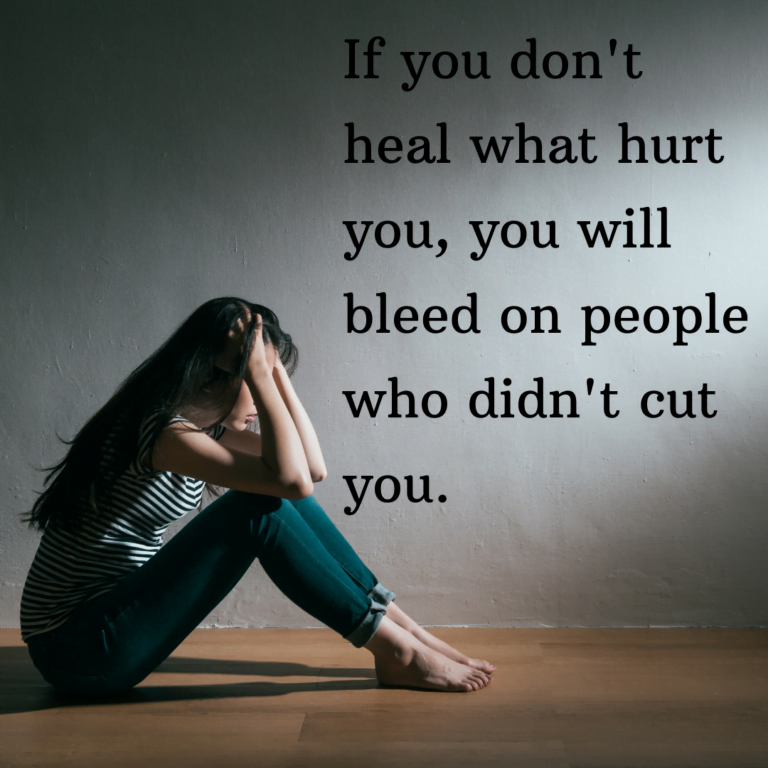
We all have baggage and scars from previous relationships and even our family of origin. Our past hurts and fears can transfer into new relationships because we are scared of the same thing happening again. Sometimes we are so afraid of something bad happening again, we treat our new partner with distrust, or we will even wound others to try to heal ourselves.
Healing what hurt us is necessary for us to have the healthy, loving relationships that we deserve. How can we begin the healing process for ourselves?
1.) Understand we have to open ourselves up to experience true intimacy with another person. We cannot have a real, meaningful relationship without opening ourselves up this way, and that means that sometimes we will get hurt. We can’t experience one without the other.
2.) Look for life lessons you can learn when you get hurt. How did this happen? Did you miss red flags? How did this make you a better person? Maybe what happened allowed you to become more sensitive or compassionate, which is an asset for all your other relationships. Or perhaps you learned what you don’t want in a partner.
3.) Forgive yourself for allowing yourself to be vulnerable and forgive the other person for hurting you. It’s hard to see this when we are hurting, but most of the time when people treat us bad, it has more to do with how they feel about themselves and what’s going on in their own head than us. We are all broken and make decisions we aren’t proud of at times. Take this as a lesson learned and let go.
4.) Talk about it with someone you trust. Holding in all your pain is not noble. It takes strength to share what’s really going on with us with other people. Sometimes just talking about how you feel and another person listening and validating your experience can make a big difference in how you look at what happened.
5.) Don’t lose your sense of self-worth. Always remember that your value as a person does not decrease if another person cannot see it. Just because someone didn’t appreciate you, doesn’t mean that others won’t. If you know your own value in relationships to begin with, weathering a breakup or betrayal will be a little easier.
More Resources to Heal What Hurt You
Books
“Man’s Search for Meaning” – Viktor Frankl recounts his Holocaust experiences. The book illustrates how finding purpose sustains resilience. He asserts that meaning in life is the central human motivational force, and one can find purpose even in suffering.
“The Art of Living” – This book is a modern paraphrase of Epictetus’ ideas. He was an important Stoic philosopher. In the book we learn that nothing is harmful except our perceptions of events. By embracing this ideal, we can let go of things outside of our control.
“The Body Keeps the Score: Brain, Mind, and Body in the Healing of Trauma” – Bessel van der Kolk delves into how trauma reshapes both body and brain. In particular, you’ll learn how trauma compromises sufferers’ capacities for pleasure, engagement, self-control, and trust. Readers can discover a new understanding of the impact of trauma and pathways to recovery.
“Trauma and Recovery” – Judith Herman’s masterwork on the field cannot be overlooked. Split into two sections, Herman helps readers identify the nature and origin of trauma. Then she helps guide you on a path of re-integration and recovery.
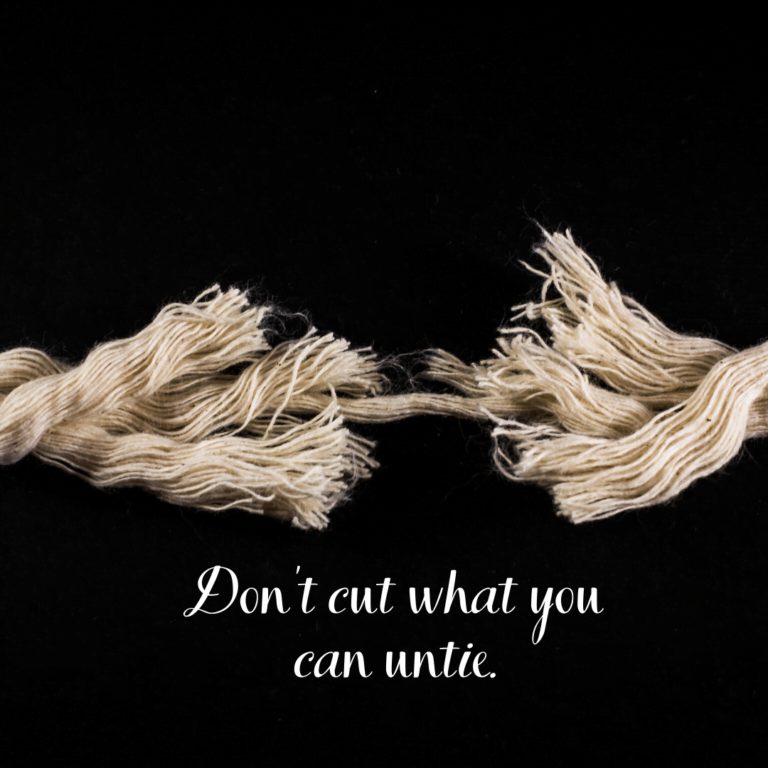
If you had a massive knot in your shoelace, would you just take a pair of scissors and cut it to get the knot undone? If you did, they would be forever altered, and your sneakers would never fit the same way they did before.
This quote is such a good one to remember in handling conflict in relationships. Often times we are really quick to lash out when we are upset or are hurt. It’s understandable because we are hurting in the moment. But before we act, we need to think about how we can most effectively handle it, that aligns with our objective, self-respect and the relationship in question. The feelings that you have are always okay and you don’t need to defend them to anyone. What you do have to do is be mindful of how you choose to respond.
For example, if my boss had promised me a promotion and instead gave it to a colleague, I shouldn’t just walk down to his office and tell him off. I need to cool off, compose myself and then schedule a meeting with him and calmly ask him what changed and how can we get me back in the running for a promotion.
With personal relationships, it can be harder. For me when my husband says something or does something that really triggers me to feel alone or insecure, I have a protocol that I try to follow. I give myself 24 hours to take a step back, think about what happened, think about how I felt and put myself in his shoes to see where he may have been coming from. Then if I feel like we need to have a conversation about it because I still feel hurt, I approach the conversation from a fair, rational place, rather than being super emotional.
This applies to saying things that you might not mean. In a fit of anger, it’s easy to say something horrible to someone you love. Once you have said it out loud to them, you can never take it back. And in turn if you untie it, you can tie it again. But if you cut it, it will never go back together.
We’ve all had to learn things the hard way at various times in our life. I’ve always been a fan of believing that if the same situations keep happening to me and I haven’t learned from it, they will continue to happen until I do.
Our time here is limited and we are meant to evolve. We are here to become better, to give more and to make our little place in this world better than how we found it. If we refuse to be open to the Universe and all that it has in store for us, we will continue to stay in the same meaningless jobs, unfulfilling relationships and chasing some ideal that we think we have to have or be.
Evolving is about progress, not perfection. It’s about learning from our failures because failure is just experience, and experience is our best teacher.
There is so much more for us on the other side of repeating our same patterns and routines. Where are areas in your life where you need to step up and evolve?
It is said that 99% of the things we worry about or are afraid of, never actually happens. Yet we grant our fears so much validity in the moment. Perhaps if we believe we think on it happening enough, we can somehow control it better when it happens. But here’s the thing: nothing can really prepare you for loss, finding out you have an illness or anything bad happening. You will never be 100% prepared because you just can’t be.
If you are like me, when you get wrapped up in your fears, you forget to live. I literally have to give myself a brief period of time to engage with my fears and then I have to force myself to take a step back and accept that things are where they are right now. And I feel scared and uncertain, but it’s okay, because I am incredibly resilient and can get through anything. I literally tell myself that sometimes over and over again. Because believe me, if I keep engaging in the worst-case scenario, it will zap me all my energy and good things that I can enjoy or experience in the moment if I let it.
Here’s a small-scale example that really illustrates this quote. A few summers ago, my husband and I went on road trip and stopped at this nature preserve that we had been looking forward to visiting for a while. As we were walking towards the trail head, I saw a small garter snake and literally froze in place. Now I know my fear of snakes is off the charts, but I literally started to shake and had tears in my eyes. Crazy, right? I did not want to go on the trail – under any circumstances. I stood there frozen.
And as I was having my panic attack over this little snake, just chilling on the side of the trail, this little girl, maybe three or four years old came by. When she saw the snake, she got excited and ran towards it, to attempt to pick it up. But he was feeling frazzled by her interest and took off into the brush. She was living in the moment, wanting to experience it all.
Now as an adult, seeing a child get excited by seeing nature up close, as you’re shaking and nearly crying because you are so afraid, is really humbling. In that moment, I remembered being a child and being so fearless of everything. Watching her reaction was honestly a beautiful thing to witness and such an amazing reminder that we choose what we give meaning to in this world.
After I saw that, I wanted to hike the trail, and I am so glad that we did. We saw so many cool things and experienced nature in a way that really feeds my soul. Was I worried about seeing more snakes on the trail? Yes. But I pushed past my fear anyway and had an amazing experience. And…that amazing experience taught me that, 1.) I can overcome my fear of snakes and 2.) the magic of this world happens outside of our fears and our comfort zone.
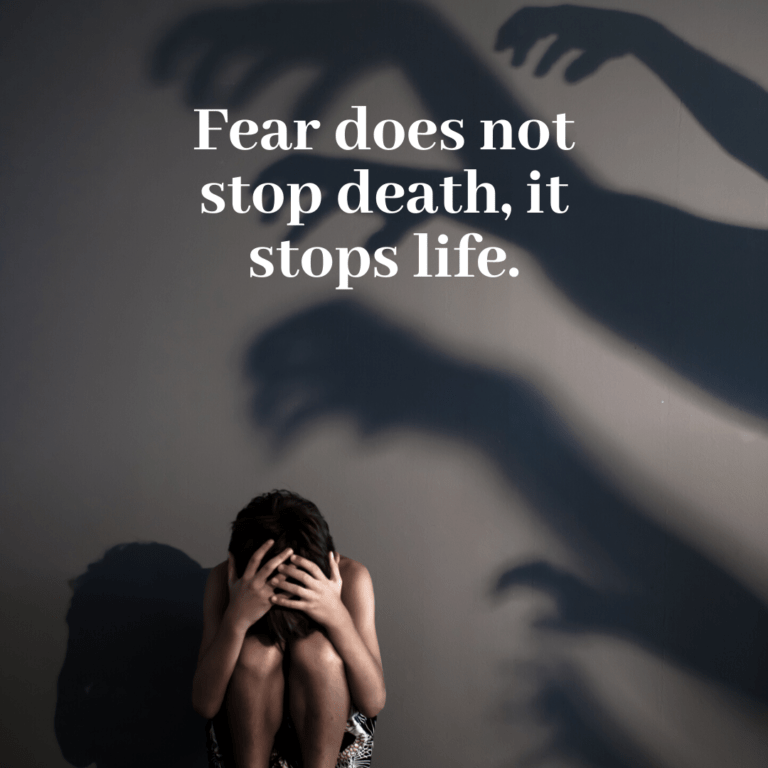
Fear stops us from living and experiencing things. If you found out that you only had 30 days to live, what would you do? Would you express your love more? Would you take more chances? Would you do all the things you have been scared to do? Would you do all the things you have been waiting until you feel “ready” to do?
Isn’t it funny how when we feel that brush with death, all we want to do is live more than we ever have before? But here’s the thing – tomorrow is promised to no one. We will all die. And we don’t know when. Fear is not going to stop death. It robs us of life.
Our time here is limited and we are perishable items. What will you do today to live like you dying?
Thanks for coming to Mindset Made Better. If you found this post helpful, consider signing up for our newsletter. I will never share your information. We’ll send emails a few times a week with new posts, featured videos and resources that will help make your mindset better.